Your chronological age.
The reference used to train and evaluate an age-estimation model.
 JOIN THE LAB ↗
Our consumer app brings brain-state awareness into daily life. The Lab explores the questions behind it: how we measure, what signals can tell us, and how we test what comes next.
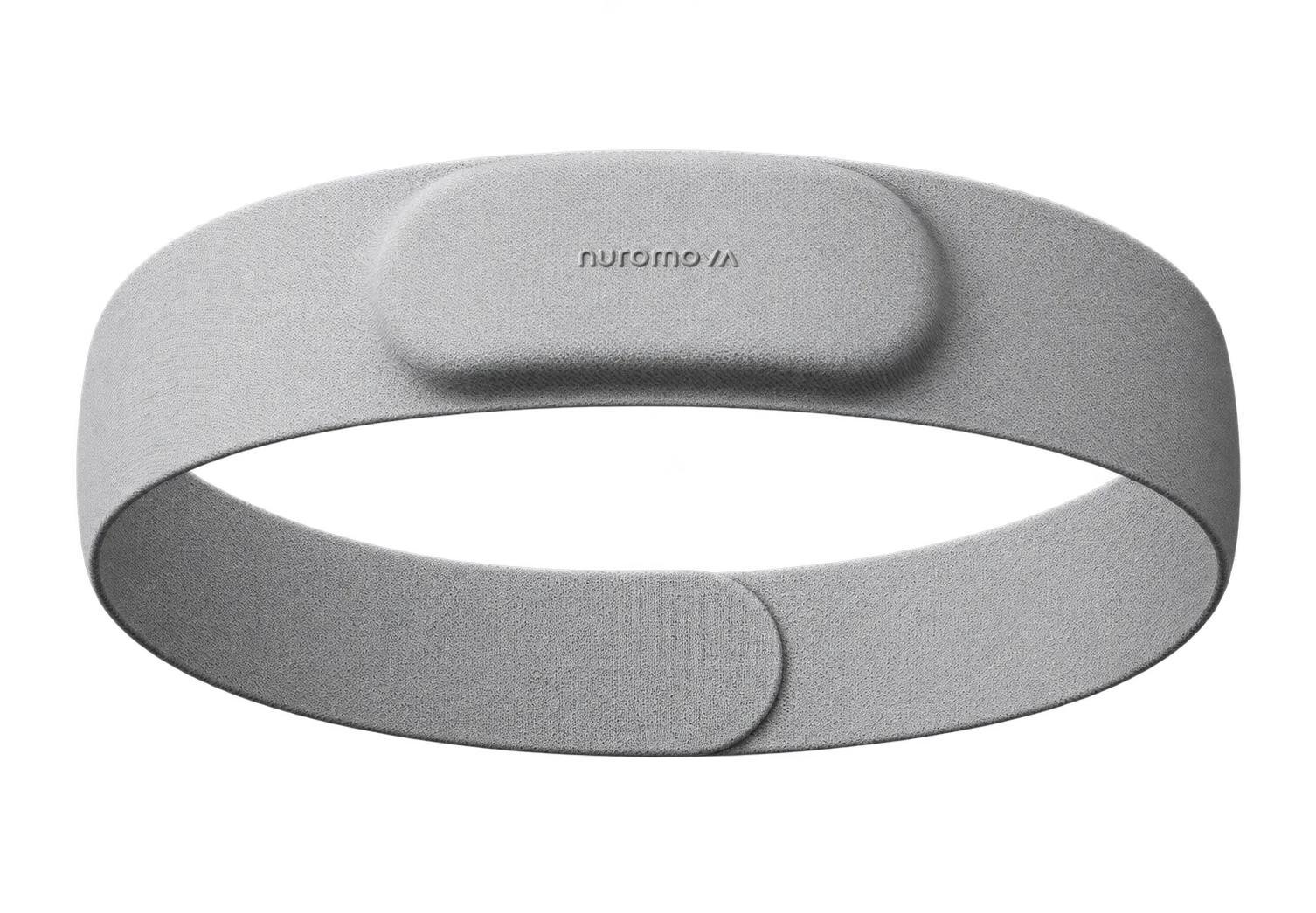
A compact setting for guided brain-state exploration, cognitive tasks and repeat measurements. Bringing the device, the participant and the assessment process together makes each session easier to understand and compare.
Our areas of interest include energy management, stress and focus. The goal is to connect everyday experience with a structured measurement process, not reduce a person to a single score.
Brain age is a model's estimate of age from patterns in brain activity, not a directly measured biological age. We are exploring whether EEG features collected with a wearable can support a meaningful, repeatable estimate.
Evidence from sleep EEG or higher-channel research equipment does not automatically validate a short, awake recording from a two-channel headband. That transfer is a research question, not an established product claim.
The reference used to train and evaluate an age-estimation model.
An output whose interpretation depends on its error and the population it was tested on.
A gap smaller than the model's error may simply reflect prediction noise.
Our development plan sets evidence gates before any individual feedback is offered.
Complete age labels and recruit across a broad age range under a consistent protocol.
Evaluate candidate EEG features, recording quality and sources of noise or confounding.
Ask whether repeated recordings produce stable observations before interpreting change.
Test on held-out participants, compare against simple baselines and report uncorrected prediction error.
Research-stage exploration. Not a medical diagnosis or screening service. Brain-age estimates must not be used to infer brain degeneration or individual disease risk. Any future feedback should make uncertainty visible rather than imply an exact age.
We are exploring how neural, physiological and behavioral information relate to one another. More signals do not automatically mean more accuracy; each combination needs its own validation.
Electrical brain activity as the neural layer, with attention to signal quality and recording conditions.
Video-based remote photoplethysmography as a complementary physiological research signal, distinct from EEG.
Blood-based measurements within separately defined study protocols and appropriate professional collection settings. The headband does not measure blood biomarkers.
Behavioral performance and personal experience provide context for interpreting physiological observations.
Modalities, eligibility and collection procedures vary by study. Not every experiment includes blood sampling or uses all modalities together.
Our brain-age work is currently at the study-planning and validation stage. Published findings will be distinguished from internal observations and ongoing experiments.
The current plan prioritizes age coverage, consistent EEG collection, repeatability and independent evaluation. Candidate features are to be tested, not assumed to work on a wearable.
Sleep, awake and laboratory recordings require separate interpretation. Published results from other devices provide research context, not evidence of Nuromova's accuracy.
Status: Development plan; no validated individual brain-age result is presented here.
Each research update should identify its question, participant group, recording method, evaluation approach, findings and limitations, with a source when available.
Peer-reviewed publications, preprints, internal reports and ongoing projects will be labeled separately. We do not list unverified publications or performance claims.
Join the Nuromova community to hear about lab experiences, relevant experiments and events. Researchers and organizations are also welcome to discuss collaboration.
Contacting us expresses interest; it does not enroll you in a study. Availability and eligibility are confirmed for each activity. Before participation, the study team should explain the protocol, data use, consent and any applicable ethics requirements. Please do not email health records or blood-test results.